How Automation Improves Operational Efficiency
Operational efficiency has become the defining factor of modern manufacturing—where productivity, consistency, and cost control determine long-term competitiveness. Whether reducing cycle times, minimizing material waste, or maintaining consistent product quality, automation now plays a central role in helping factories achieve production goals.
For machine builders, OEMs, and manufacturers, automation is no longer just a supporting tool. It is a strategic capability that directly influences profitability, reliability, and scalable growth.
This article explains how automation improves operational efficiency, the key areas where it delivers measurable value, and why industries worldwide are adopting servo-based motion control and IoT-ready systems to remain competitive.
What is Operational Efficiency?
Operational efficiency refers to a factory’s ability to produce greater output while using fewer resources such as time, manpower, energy, and raw materials. It does not only mean lowering operational expenses — it also means achieving consistent production quality, minimizing process variability, and fulfilling customer demand reliably.
An efficient manufacturing system ensures machines operate predictably, operators work effectively, and resources are utilized optimally. When inefficiencies occur, they appear as scrap generation, production delays, inconsistent product quality, and excessive energy consumption. Automation addresses these issues by stabilizing processes and improving repeatability.
Operational efficiency therefore combines cost optimization, process stability, and production reliability into a single measurable objective.
The Role of Automation in Driving Efficiency
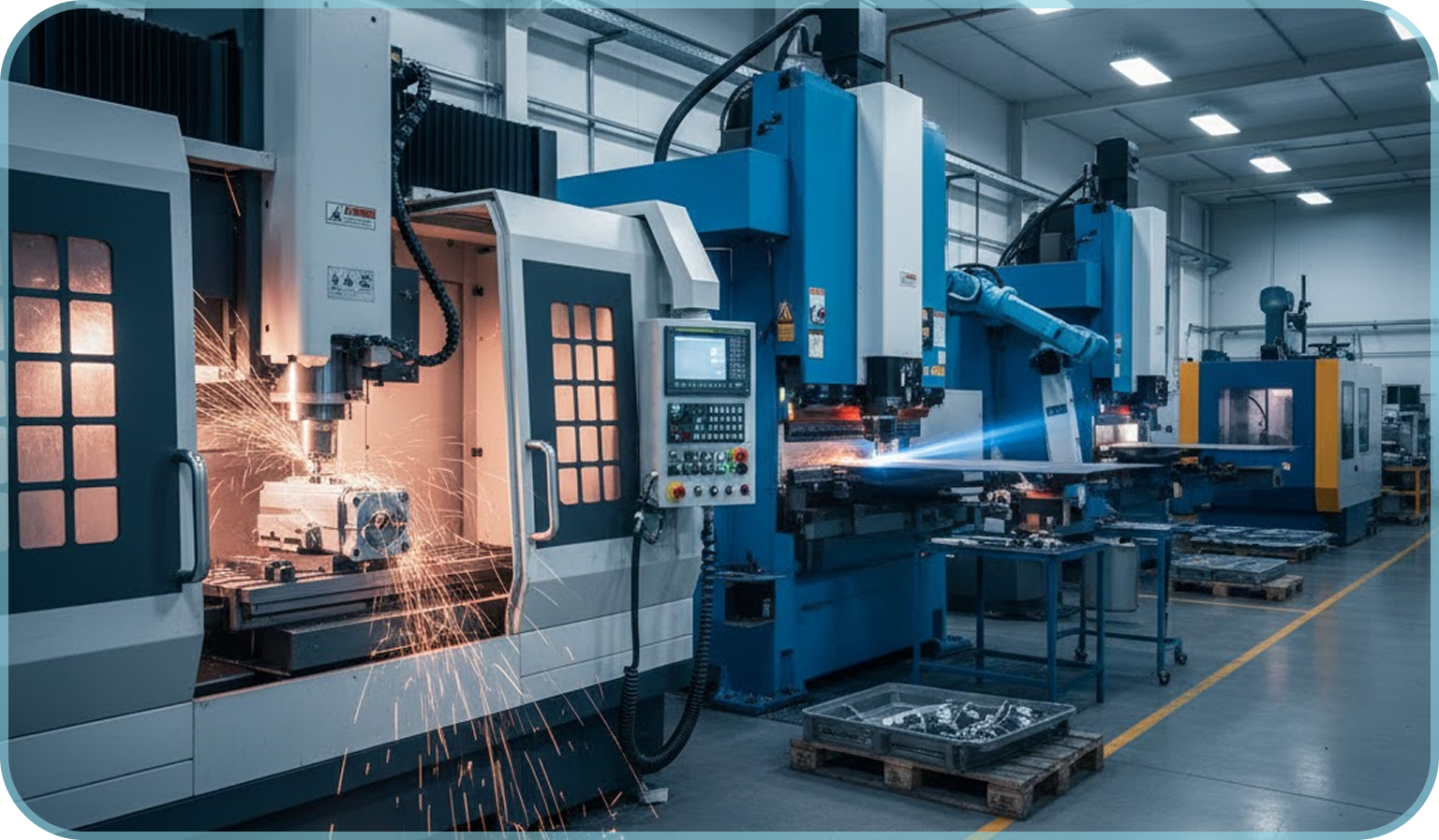
Automation enables machines and control systems to perform tasks with speed, accuracy, and repeatability beyond manual capability. In manufacturing environments, even small improvements in machine performance produce significant gains when multiplied across thousands of production cycles.
Key operational advantages include:
1. Reduced Cycle Times
Automation reduces delays in repetitive manufacturing operations. For example, injection molding machines equipped with servo-driven motion controllers can complete cycles faster while maintaining stable processing parameters. Faster cycle completion directly increases daily production output.
2. Improved Product Quality
Automated controllers maintain consistent pressure, speed, and temperature settings throughout the process. This ensures uniformity across produced components and significantly lowers rejection rates, rework, and material scrap.
3. Lower Operational Costs
Servo-based automation systems consume energy only when motion is required. Compared with traditional hydraulic systems, this reduces power consumption substantially and results in long-term operating cost savings.
4. Minimized Human Error
Automation reduces dependency on manual adjustments. Modern HMIs provide guided configuration, alarms, and monitoring interfaces that help operators manage machines confidently and prevent operational mistakes.
5. Data-Driven Insights
IoT-enabled automation systems continuously collect machine data and generate operational reports. These insights help manufacturers analyze performance trends, optimize processes, and make informed production decisions.
6. Higher Machine Uptime
Predictive maintenance supported by sensors and monitoring systems detects early warning signs before breakdowns occur. This reduces unexpected downtime and increases overall equipment availability.
Examples of Automation Improving Efficiency
Automation improves efficiency across multiple industrial sectors and applications:
- Injection Molding: Automated HMIs maintain stable molding cycles, reduce material scrap, and improve dimensional accuracy even during high-volume production.
- Hydraulic Presses: Servo motion control allows smoother operation, optimized energy usage, and consistent forming performance under heavy loads.
- Packaging Lines: Automated synchronization between machines maintains throughput, reduces changeover time, and prevents bottlenecks along the production line.
Automation & Industry 4.0
Traditional automation focused primarily on replacing manual labor. Modern automation, integrated with Industrial IoT technologies, extends far beyond that objective. Connected machines now communicate operational data continuously and support intelligent production systems.
Industry 4.0 automation enables:
- Real-time monitoring of machine parameters
- Remote diagnostics and troubleshooting
- Predictive maintenance scheduling
- Performance analytics and reporting
These capabilities transform automation from a cost-reduction method into a strategic driver of operational resilience and competitive advantage.
Why Modern Motion Control Solutions Matter
Advanced motion control and automation platforms provide long-term value by improving productivity and ensuring reliable machine performance. Modern HMIs and controllers are designed for industrial environments where uptime, reliability, and ease of use are critical.
Well-designed automation solutions offer:
- Stable machine operation in demanding conditions
- Energy-efficient performance through servo technology
- User-friendly interfaces suitable for all operator skill levels
- Compatibility with Industry 4.0 connectivity systems
- Reliable performance across multiple industrial applications
Conclusion
Automation has evolved from an optional productivity improvement into a necessity for modern manufacturing. By stabilizing processes, reducing operational costs, improving product quality, and enabling data-driven decisions, automation directly enhances operational efficiency.
Manufacturers that adopt automation today gain the ability to scale production, meet increasing demand, and maintain consistent quality standards. In an increasingly competitive industrial environment, efficient factories will be those that implement intelligent automation systems early and continuously improve them.